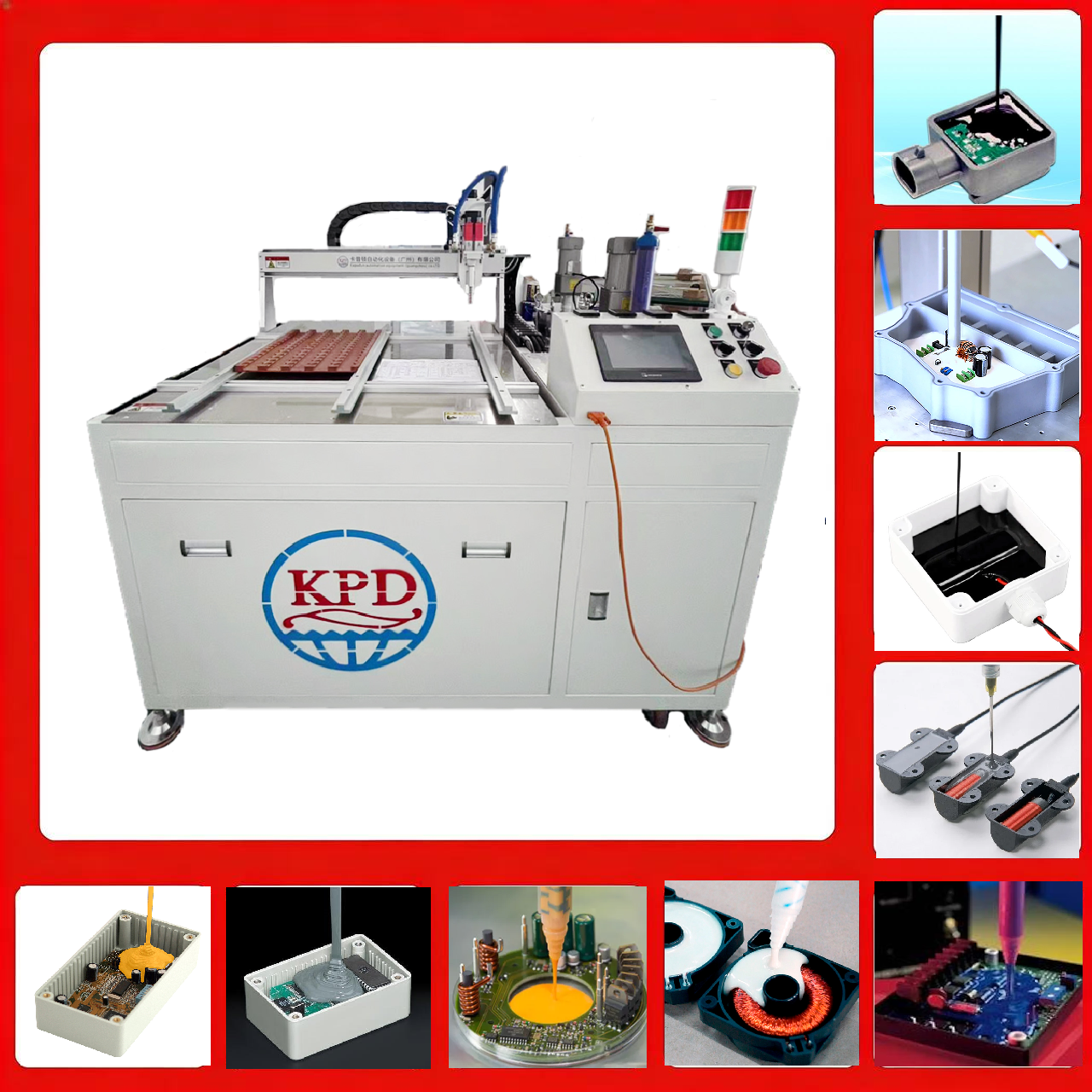
Automotive radars PUR resin potting machine meter mix dispenser glue dispenser
Why Is Potting Necessary for Automotive Radars? Core Functions and Technical Value
Automotive radars, including millimeter-wave radars and lidars, serve as the "eyes" of advanced driver-assistance systems (ADAS) and autonomous driving technologies. They are tasked with detecting obstacles, measuring distances, and identifying targets in complex road environments. Potting—typically using two-component AB epoxy resin—is a critical manufacturing process for automotive radars. It not only protects internal components from harsh working conditions but also ensures stable detection performance and long-term reliability, making it an indispensable step in radar production.
1. Extreme Environmental Protection Against Harsh Conditions
Automotive radars are usually mounted on the front bumper, rear end, or side of the vehicle, exposing them to extreme temperatures, humidity, dust, rain, and ultraviolet (UV) radiation. The dense resin layer formed after potting provides IP67/IP68-level waterproof and dustproof protection, effectively isolating rainwater, mud, and dust from invading the internal printed circuit boards (PCBs), sensor chips, and antennas.
Moreover, AB epoxy resin exhibits excellent resistance to temperature cycles, withstanding extreme ranges from -40℃ to 85℃ without cracking or deforming. This prevents component aging and performance degradation caused by drastic temperature changes. It also blocks UV radiation to avoid material deterioration, ensuring the radar maintains stable performance even after long-term outdoor exposure.
2. Structural Fixation and Vibration Impact Buffering
Vehicles generate continuous vibration during operation, and bumpy roads or minor collisions can cause instantaneous impact. Automotive radars have extremely high requirements for component position accuracy—even tiny displacements can lead to deviations in detection distance and angle, affecting ADAS decision-making.
Potting resin fully encapsulates and fixes internal components such as chips, antennas, and wires to the radar housing, eliminating gaps between parts. This reduces wear and displacement caused by vibration, prevents solder joint detachment and wire loosening, and maintains the structural stability of the radar. For millimeter-wave radars, in particular, precise component positioning ensured by potting is crucial for maintaining signal transmission and reception accuracy.
3. Thermal Conductivity Optimization for Stable Performance
Radar chips and circuits generate heat during operation. If heat accumulates, it will cause chip overheating, reduce detection sensitivity, and even burn out components. AB epoxy resin used for radar potting has excellent thermal conductivity, forming an efficient heat transfer path between internal components and the radar housing.
This allows heat generated by the chip to be quickly conducted to the housing and dissipated into the air, keeping the chip operating at a stable temperature range (usually 25℃ to 60℃). Stable temperature control ensures the radar maintains consistent detection accuracy and response speed, even during prolonged high-load operation.
4. Electromagnetic Shielding and Insulation to Avoid Interference
The automotive electronic system is complex, with engines, on-board appliances, and other components generating electromagnetic interference (EMI). Meanwhile, internal radar components require effective insulation to prevent short circuits. Potting resin acts as an electromagnetic shielding layer, blocking external EMI from interfering with radar signal transmission and reception.
It also provides reliable insulation between components, isolating metal pins and PCB traces to avoid short circuits, leakage, and other faults. This is particularly important for high-frequency radars, as stable electromagnetic performance ensures accurate target identification and reduces false alarms.
5. Corrosion Resistance for All-Scenario Adaptability
Vehicles may come into contact with corrosive substances such as acid rain, road salt (used for deicing in winter), and oil stains during operation. These substances can corrode metal pins, PCB boards, and connectors, leading to radar failure. The potting layer forms a protective barrier, isolating corrosive media from internal components.
This adaptability makes automotive radars suitable for special scenarios such as coastal areas (high salt spray) and alpine regions (road salt), ensuring reliable operation throughout the vehicle's service life (typically 10 to 15 years).
Technical Connection with Epoxy Doming Machines
Automotive radar potting and crystal sticker doming share core technologies ofautomated AB resin proportioning and precise dispensing. While crystal sticker doming machines focus on surface forming and aesthetic effects, radar potting requires higher precision (mixing ratio error ≤ ±1%), deeper filling capacity, and stronger adhesion. Both rely on servo-driven precision metering pumps and dynamic mixing modules to achieve uniform resin mixing, ensuring consistent product performance—reflecting the versatility of automated AB resin processing equipment across industries.
In summary, potting is a vital process that determines the reliability and performance of automotive radars. By integrating protection, fixation, heat dissipation, and anti-interference functions, AB epoxy resin potting enables radars to adapt to the harsh automotive environment, laying a solid foundation for the safe operation of ADAS and autonomous driving systems.
Choose our Glue Potting Machine will help you alot and contact us directly by whatsapp+86 134 2516 4065