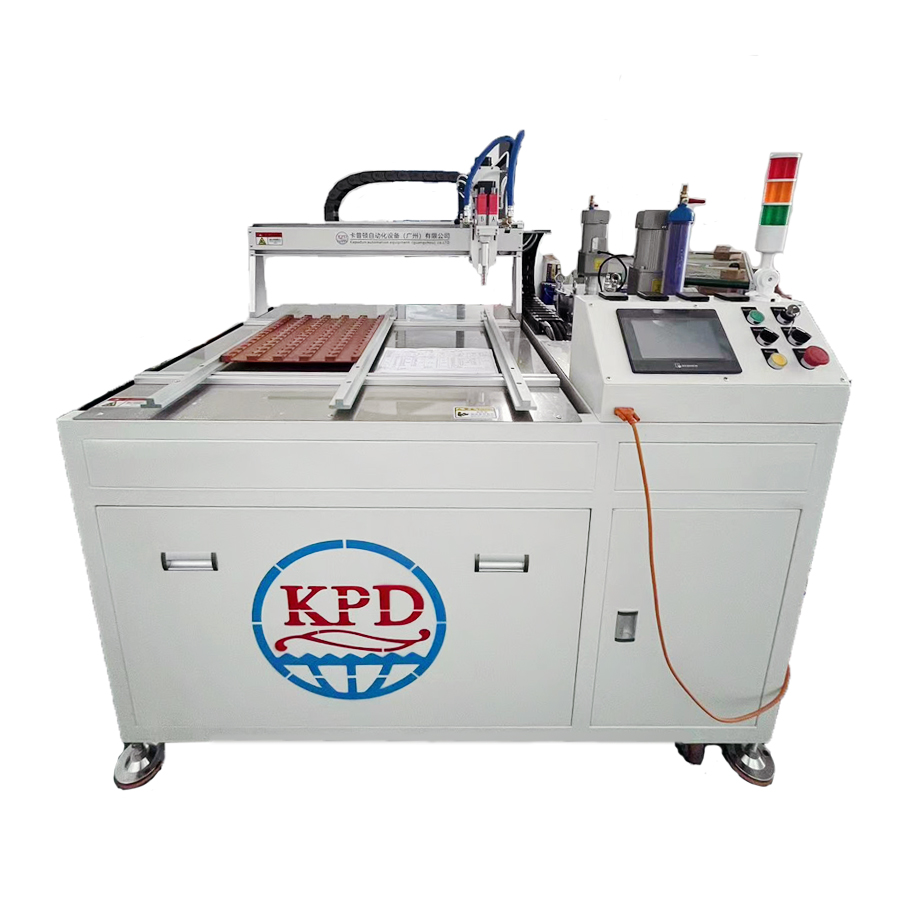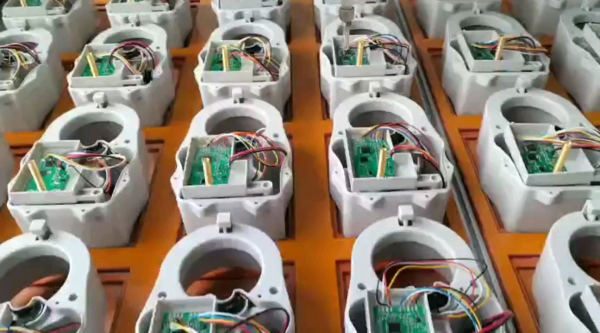
In modern urban life, water meters, as key instruments for measuring water consumption, are crucial for their reliability and stability. Have you ever wondered how a small water meter withstands sun, rain, and moisture to ensure the long-term stable operation of its internal precision components? Behind this lies a precise process called “glue potting,” which plays an indispensable role. With the advancement of smart technology, traditional glue potting methods are being revolutionized by a more efficient and precise piece of equipment—the smart water meter glue potting machine.
I. What is Glue Potting? Why Do Water Meters Need Glue Potting?
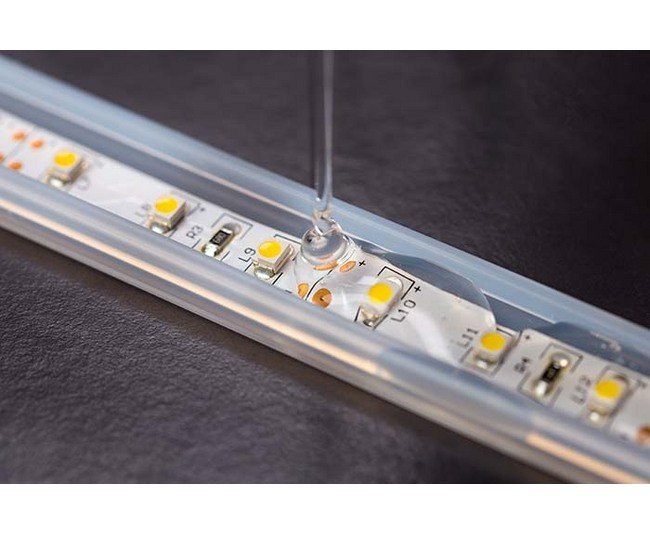
Before delving into the machine itself, we first need to understand the glue potting process. Glue potting specifically refers to injecting a specific liquid sealing material (usually epoxy resin, polyurethane, or other adhesives) into the inside of the water meter casing, allowing it to cure and form a protective seal.
The core purposes of water meter glue potting are threefold:
1. Sealing and Protection: This is the most basic and important function. The cured glue effectively fills the internal space of the casing, forming a reliable sealing barrier to prevent the intrusion of external media such as moisture, water vapor, and dust. This is crucial for water meters installed in damp and easily seeping environments such as outdoors, in wells, and basements, ensuring their long-term normal operation.
2. Structural Reinforcement: After the adhesive cures, it firmly bonds and fixes the internal components of the water meter, such as the movement, sensors, and circuit boards, within the meter casing, forming a more robust and integrated structure. This significantly improves the water meter’s resistance to mechanical vibration and impact, preventing metering inaccuracies or damage due to loosening during transportation, installation, or use.
3. Insulation and Thermal Conductivity: For smart water meters (such as those with electronic modules and remote transmission functions), the internal electronic components require good insulation protection to prevent short circuits. Some adhesives also possess certain thermal conductivity properties, helping to evenly dissipate the heat generated by the electronic components during operation, improving their operational stability and lifespan.
Traditional glue application relies heavily on manual or semi-automatic equipment, resulting in problems such as inaccurate glue volume control, poor consistency in application location, difficulty in removing air bubbles, and limited production efficiency. The emergence of smart water meter glue application machines aims to solve these pain points, elevating the glue application process to a new level.
II. Core Components and Working Principle of a Smart Water Meter Glue Dispensing Machine
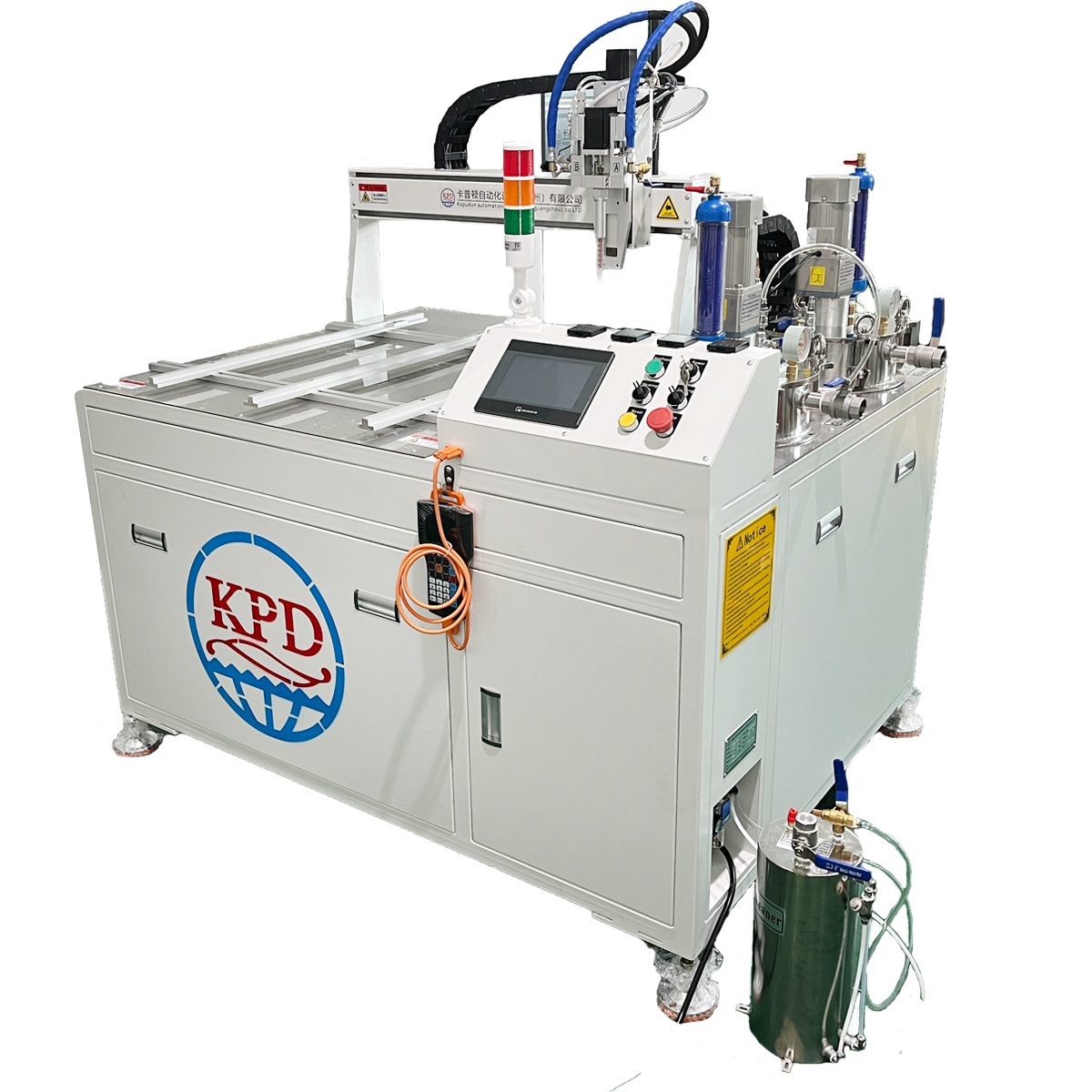
A typical smart water meter glue dispensing machine is not simply a “glue dispensing” tool, but an automated system integrating multiple technologies such as mechanics, control, sensing, and vision. Its core workflow can be summarized in the following steps:
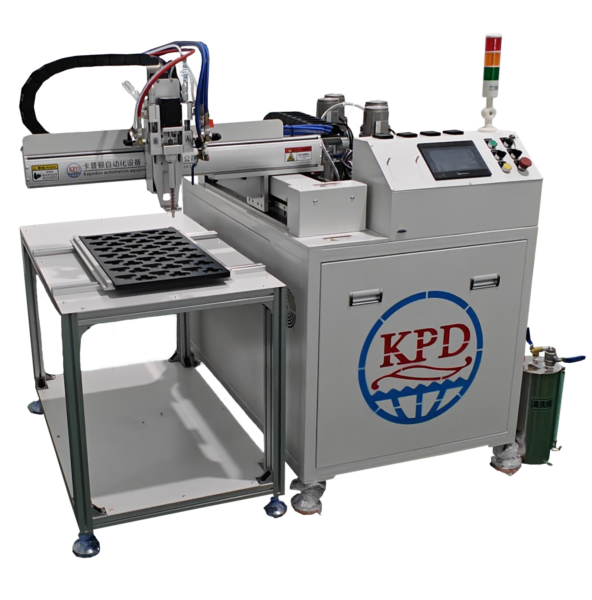
1. Precise Material Feeding and Positioning: The water meter casing is precisely transported to the dispensing station via an automated conveyor line (such as a conveyor belt or rotary table). A machine vision system or a precision mechanical positioning device identifies and calibrates the casing, ensuring that each product to be dispensed is at a preset, precise coordinate, laying the foundation for subsequent precise dispensing.
2. Dynamic Proportioning and Mixing: This is one of the key technical aspects. Many high-performance sealants consist of two (or more) components, A and B, which need to be mixed in real-time according to strict proportions before dispensing. The intelligent dispensing machine incorporates a high-precision metering pump and a dynamic mixing device, capable of continuously and in real-time extracting each component according to a set ratio and mixing them uniformly in an instant, ensuring consistent sealant performance with each dispensing.
3. Precise Dispensing via a Three-Dimensional Path: The “brain” of the intelligent dispensing machine—the control system—directs the dispensing head to perform complex movements in three-dimensional space according to a preset program. It can dispense along specific trajectories inside the water meter casing, such as circling around the electronic module or filling specific cavities, rather than simply dispensing at fixed points. This ensures that the adhesive covers the areas requiring protection evenly and without any blind spots, while avoiding waste.
4. Precise Control of Process Parameters: Throughout the dispensing process, the machine implements closed-loop control of key parameters such as adhesive volume, dispensing speed, adhesive temperature, and discharge pressure. For example, a high-precision flow meter ensures that each water meter receives the exact same amount of adhesive; a constant temperature system maintains stable adhesive viscosity, thus guaranteeing highly consistent dispensing quality for each water meter.
5. Bubble Management and Quality Monitoring: Advanced equipment integrates degassing or vacuum dispensing functions to effectively eliminate air bubbles after adhesive mixing or during dispensing, preventing voids in the cured adhesive that could affect sealing and insulation performance. Some systems are also equipped with a visual inspection unit to automatically check for surface smoothness and any missing or overflowing adhesive after dispensing, achieving online quality control.
III. Significant Advantages of Intelligentization
Compared to traditional methods, the application of intelligent water meter dispensing machines brings multi-dimensional improvements:
* Leap in Quality Consistency: The machine eliminates the fluctuations caused by human operation, ensuring that the dispensing depth, amount, and coverage of thousands of water meters are almost identical, fundamentally guaranteeing product reliability.
* Significantly Increased Production Efficiency: Automated continuous operation, combined with rapid positioning and high-speed, precise dispensing, significantly accelerates the production cycle, meeting the needs of large-scale centralized production.
* Effective Savings in Material Costs: Precise dispensing volume control and path planning innovatively minimize adhesive waste, reducing the material cost per unit.
* Improved Production Environment and Safety: Freeing operators from repetitive labor and environments where they may come into contact with chemical adhesives, resulting in a cleaner production site that aligns with modern green manufacturing principles.
* Process Traceability and Adjustability: All dispensing parameters (such as formula ratios, dispensing paths, speeds, etc.) are digitally stored, facilitating product quality traceability. When the water meter model or adhesive changes, production can be quickly switched by simply retrieving or modifying the corresponding program, offering a high degree of flexibility.
IV. Technological Development Trends and Prospects
As water meter products evolve towards higher precision and more functions (such as IoT and big data applications), more refined requirements are being placed on the dispensing process. Future intelligent dispensing technology may exhibit the following trends:
* Higher Precision and Adaptability: For smaller electronic components and more complex internal structures of the meter casing, the precision of dispensing path planning and execution will be further improved, even possessing intelligent learning capabilities to adapt to different product models.
* Multi-Material Composite Applications: Different types of adhesives with varying properties (such as different hardness, thermal conductivity) may be dispensed into different parts of the same water meter according to requirements, achieving differentiated protection for different zones. This poses a challenge to the machine’s multi-path control and switching capabilities.
* Deep Integration into Smart Manufacturing Systems: Dispensing machines will no longer be isolated information silos, but will seamlessly connect with other equipment on the production line (such as assembly machines and testing machines) and upper-level management systems through the Industrial Internet, enabling real-time uploading of production data and receiving of instructions, becoming a highly collaborative intelligent node in the smart factory.
*Environmental Protection and New Materials: With increasingly stringent environmental regulations, new environmentally friendly adhesives such as low-VOC and bio-based adhesives will be used. Dispensing equipment needs to adapt to the rheological properties of these new materials to ensure process stability.
In conclusion, the smart water meter dispensing machine is a key piece of equipment in the modern metering instrument manufacturing field. Although it doesn’t directly face the end consumer, its stable, precise, and efficient “hand” and “brain” silently safeguard the core of each water meter, ensuring the accuracy and reliability of water metering data. It contributes indispensable technical strength to the intelligent and refined management of urban water supply networks and the scientific utilization of water resources. From the precise application of a single drop of adhesive to the clear understanding of a city’s waterways, this embodies the subtlety and profoundness of modern intelligent manufacturing.