Choosing the right potting machine is an important decision for manufacturers working with electronic components, PCBs, LED modules, sensors, transformers, automotive electronics and other products that require protection through potting or encapsulation.
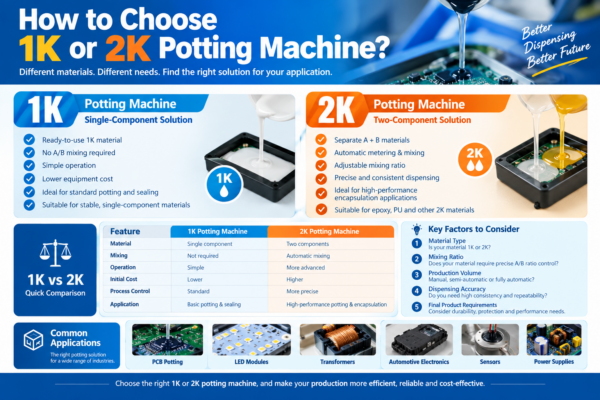
One of the first questions manufacturers need to answer is:
Should you choose a 1K or 2K potting machine?
The answer mainly depends on the type of potting material, whether the material requires mixing, the required dispensing accuracy, production volume and the final performance requirements of the product.
In this guide, we explain the differences between 1K and 2K potting machines and help you determine which solution is better for your production process.
What Is a 1K Potting Machine?
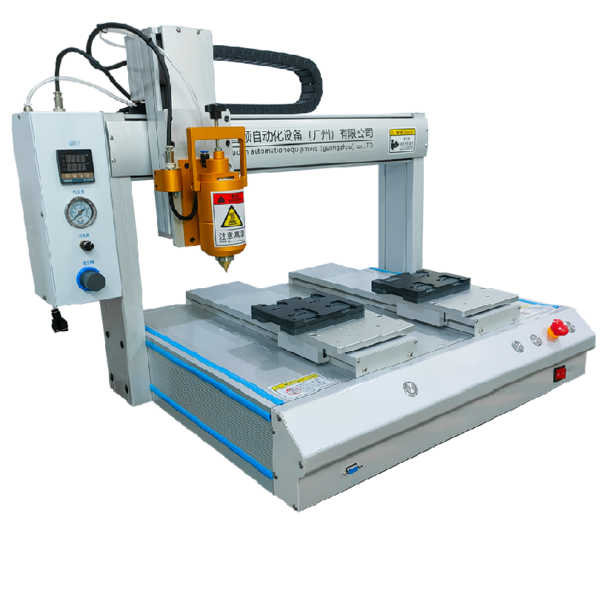
A 1K potting machine is designed to dispense a single-component potting material.
“1K” means one component. The material is supplied as a ready-to-use compound and does not require the machine to combine two separate materials before dispensing.
Depending on the material, curing may occur through heat, moisture, UV exposure or another curing mechanism.
A 1K potting system is generally simpler because there is no A/B material mixing process.
Advantages of a 1K Potting Machine
- Simple material handling
- No A/B mixing required
- Easy operation
- Simple dispensing process
- Lower system complexity
- Suitable for many single-component materials
- Easy integration into automated production lines
A 1K potting machine can be a good choice when the material is already prepared by the adhesive or potting compound manufacturer and does not require two-component mixing.
What Is a 2K Potting Machine?
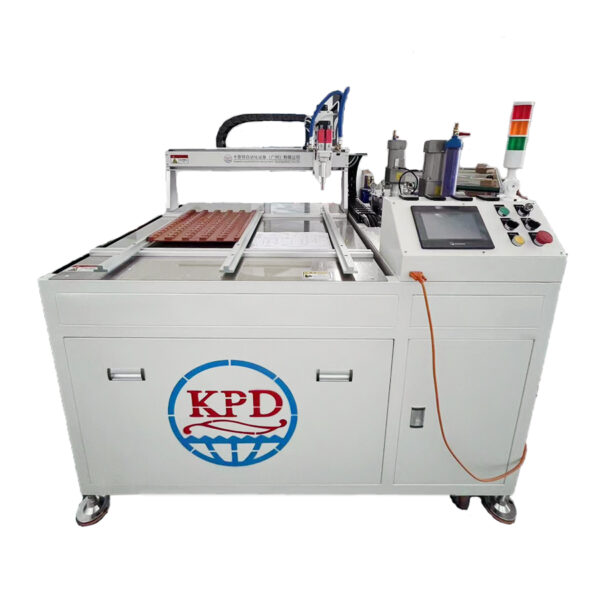
A 2K potting machine is designed for two-component materials.
“2K” means two components, normally referred to as Component A and Component B.
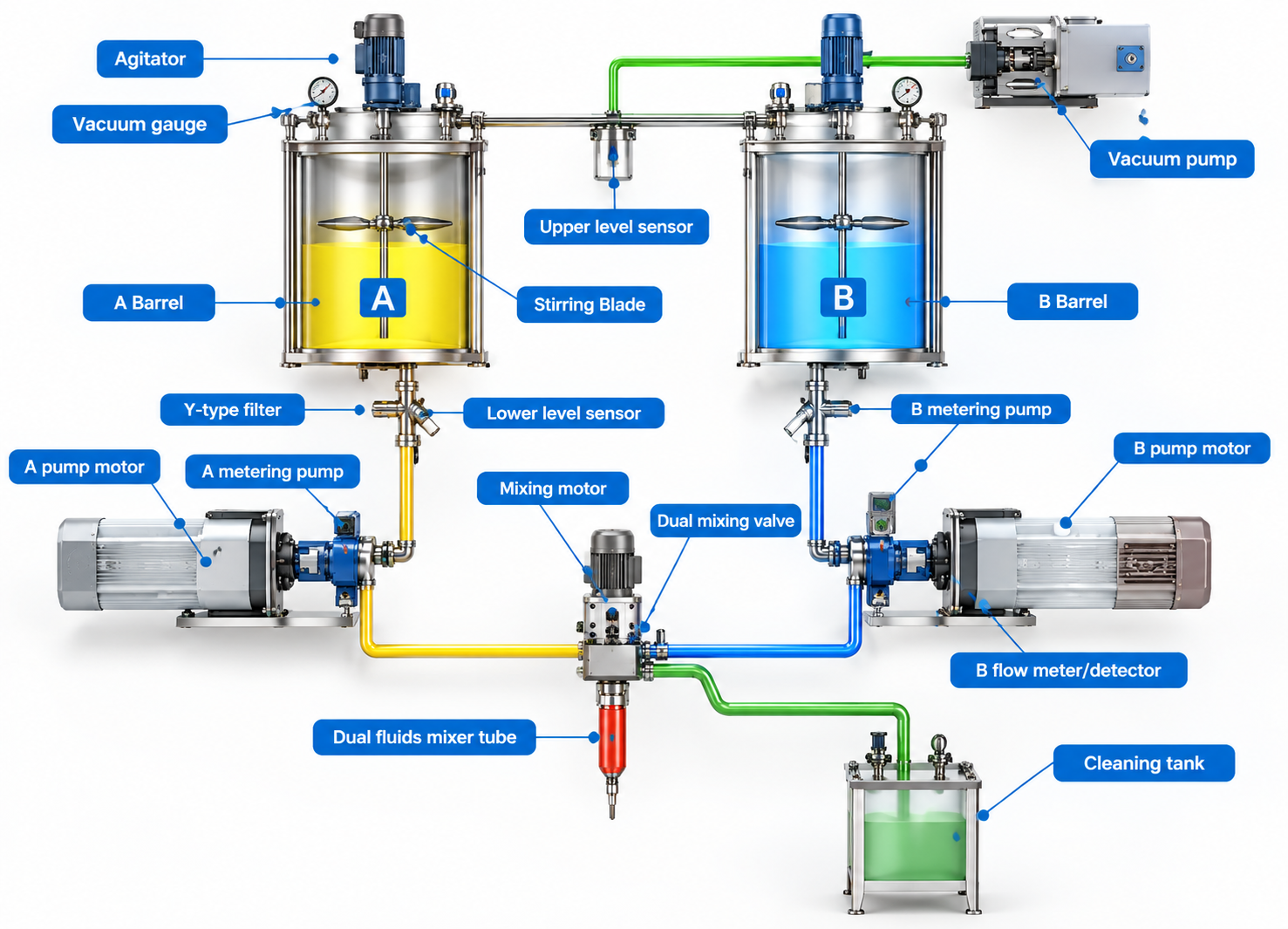
The two materials are stored separately and accurately metered before being mixed and dispensed into the product.
For example, a typical 2K system may process:
- 2K Epoxy
- 2K Polyurethane (PU)
- Two-component silicone
- Two-component adhesives
- Other reactive potting compounds
The 2K potting machine controls the material supply, metering ratio, mixing process and dispensing operation.
Advantages of a 2K Potting Machine
- Precise A/B material metering
- Automatic material mixing
- Adjustable mixing ratio
- Consistent dispensing
- Suitable for reactive two-component materials
- Reduced manual mixing
- Better process repeatability
- Suitable for high-volume production
- Flexible automation options
For applications where the potting compound must be precisely mixed immediately before application, a 2K system is usually the more suitable solution.
1K vs 2K Potting Machine: What Is the Difference?
The biggest difference between a 1K and 2K potting machine is material preparation.
A 1K system dispenses one component, while a 2K system independently meters two components and mixes them before dispensing.
| Feature | 1K Potting Machine | 2K Potting Machine |
|---|---|---|
| Material | Single component | Two components |
| A/B Mixing | Not required | Required |
| Metering | Single material | A + B materials |
| Mixing System | Not required | Static or dynamic mixing |
| System Complexity | Lower | Higher |
| Operation | Simple | More advanced |
| Process Control | Standard | Advanced |
| Mixing Ratio Control | Not applicable | Required |
| Material Cost | Depends on material | Depends on material |
| Automation | Available | Available |
| Typical Applications | Potting, sealing, coating | Potting, encapsulation, sealing |
| Best For | Ready-to-use materials | Reactive A+B materials |
How to Choose Between a 1K and 2K Potting Machine
There are five major factors to consider before purchasing a potting machine.
1. Check Your Potting Material
The first and most important question is:
Is your material 1K or 2K?
If your potting compound is a single-component material that is ready for dispensing, a 1K potting machine may be sufficient.
If your material contains two separate components that must be mixed at a specific ratio before curing, you need a 2K potting machine.
For example:
1K material → 1K potting machine
A + B material → 2K potting machine
Always check the technical data sheet provided by your material supplier before selecting the equipment.
2. Consider the Required Mixing Ratio
Mixing ratio is one of the most important factors when selecting a 2K dispensing machine.
Two-component materials may require different ratios, such as:
- 1:1
- 2:1
- 3:1
- 4:1
- Other customized ratios
The potting machine must be configured according to the material manufacturer’s specified ratio.
A properly configured 2K metering and mixing system can automatically control the amount of Component A and Component B supplied to the mixing system.
This helps reduce the risk of manual mixing errors and improves process consistency.
3. Consider Production Volume
Your production volume also affects the choice of potting equipment.
For low-volume production, a simpler dispensing solution may be sufficient.
For medium- and high-volume production, an automatic potting machine can provide greater consistency and reduce manual labor.
If your production requires:
- Repetitive dispensing
- High production speed
- Consistent shot volume
- Automatic positioning
- Multiple products
- Conveyor integration
a fully automatic potting system may be a better choice.
For advanced production lines, a 2K potting machine can be integrated with XYZ positioning systems, conveyors, robots and other automation equipment.
4. Consider Dispensing Accuracy and Repeatability
Potting applications often require a specific amount of material to be dispensed into a defined area.
Too little material may leave part of the product unprotected.
Too much material can increase material consumption, curing time and production costs.
A suitable automatic potting machine should therefore provide stable and repeatable material delivery.
For 2K materials, the system must also maintain the required A/B mixing ratio during dispensing.
Factors that can affect dispensing performance include:
- Material viscosity
- Material temperature
- Mixing ratio
- Pump technology
- Dispensing volume
- Dispensing speed
- Material fillers
- Curing characteristics
Therefore, machine selection should be based on the actual material and application rather than the machine name alone.
5. Consider Your Final Product Requirements
The final product application is another important consideration.
Electronic components may require potting for:
- Electrical insulation
- Moisture protection
- Dust protection
- Vibration resistance
- Environmental protection
- Mechanical protection
- Thermal management
For example, PCB potting, transformer encapsulation and automotive electronic protection may require different materials and dispensing processes.
The correct potting machine should match both the material and the product requirements.
When Should You Choose a 1K Potting Machine?
A 1K potting machine may be the better option when:
- Your material is single-component
- No A/B mixing is required
- The material is ready to use
- The application is relatively straightforward
- You want a simpler dispensing system
- Your production requirements do not require two-component metering
A 1K system can provide an efficient solution for many standard potting, sealing and dispensing applications.
When Should You Choose a 2K Potting Machine?
A 2K potting machine is generally appropriate when:
- Your material has two components
- Component A and B must be mixed before curing
- A precise mixing ratio is required
- You need automatic metering and mixing
- Consistent material preparation is important
- You need repeatable production quality
- You are processing 2K epoxy, PU or other reactive materials
A 2K system can eliminate manual A/B mixing and provide a more controlled dispensing process.
1K or 2K Potting Machine for Electronics?
Electronics manufacturing is one of the most common applications for automated potting and encapsulation.
Typical applications include:
- PCB potting
- LED module potting
- Transformer potting
- Sensor encapsulation
- Power supply potting
- Electronic component encapsulation
- Automotive electronics
- Control modules
- Electrical connectors
- Industrial electronic devices
The best machine depends primarily on the selected potting compound.
For example, if the material is a ready-to-use single-component compound, a 1K dispensing system may be appropriate.
If the material requires Component A and Component B to be accurately mixed, a 2K potting system is required.
1K vs 2K: Which One Is More Cost-Effective?
It is important not to compare only the initial machine price.
A 1K system generally has a simpler structure and may have a lower initial equipment cost.
A 2K system is more complex because it requires separate material storage, metering and mixing functions.
However, the more important question is:
Which machine provides the lowest total production cost for your application?
Consider:
- Material consumption
- Labor requirements
- Production speed
- Scrap rate
- Mixing consistency
- Maintenance
- Automation requirements
- Production volume
- Product quality
For high-volume manufacturing, automation and process consistency can be more important than the initial equipment investment.
Can One Potting Machine Process Both 1K and 2K Materials?
This depends on the machine design.
A standard 1K potting machine is designed for single-component materials and cannot automatically perform the A/B metering and mixing required by a 2K process.
Some customized dispensing systems may be designed with greater flexibility, but compatibility must be evaluated based on:
- Material viscosity
- Chemical properties
- Mixing ratio
- Pump type
- Dispensing volume
- Curing time
- Cleaning requirements
Manufacturers should provide the material technical data sheet and application requirements when requesting a customized solution.
How Does a 2K Potting Machine Work?
A typical automatic 2K potting process includes several steps:
Step 1: Material Storage
Component A and Component B are stored in separate tanks.
Step 2: Material Metering
The machine accurately controls the amount of each component according to the required ratio.
Step 3: Material Mixing
The two components are combined through a static or dynamic mixing system.
Step 4: Automatic Dispensing
The mixed material is dispensed into the target product.
Step 5: Curing
The filled product is transferred to the appropriate curing process according to the material manufacturer’s requirements.
This automated process helps reduce manual operation and improve dispensing consistency.
Key Questions to Ask Before Buying a Potting Machine
Before purchasing a 1K or 2K potting machine, prepare the following information:
Material
- What is the material type?
- Is it 1K or 2K?
- What is the viscosity?
- What is the mixing ratio?
- What is the curing time?
- Does it contain fillers?
Product
- What are the product dimensions?
- Where does the material need to be dispensed?
- What is the required potting volume?
- Does the product require full or partial encapsulation?
Production
- How many pieces are produced per hour?
- What dispensing accuracy is required?
- Is manual, semi-automatic or fully automatic production required?
- Does the system need conveyor integration?
Providing this information allows the equipment manufacturer to recommend a more suitable dispensing system.
1K or 2K Potting Machine: Quick Decision Guide
Use this simple guide:
Choose 1K if:
Your material is single-component and ready to dispense.
Choose 2K if:
Your material contains Component A + Component B and requires controlled mixing.
Choose an automatic system if:
You need high production efficiency, repeatability and reduced manual operation.
Choose a customized system if:
Your product requires special dispensing paths, large volumes, multiple dispensing points or production-line integration.
Conclusion
Choosing between a 1K and 2K potting machine starts with understanding your material.
A 1K potting machine is suitable for single-component materials that do not require A/B mixing. It offers a relatively simple and efficient dispensing solution.
A 2K potting machine is designed for two-component materials that require accurate metering, mixing and dispensing. It is particularly suitable for applications where mixing ratio, process consistency and production automation are important.
The right solution ultimately depends on your material properties, mixing requirements, dispensing volume, production capacity and product performance requirements.
If you are unsure whether a 1K or 2K system is suitable for your application, provide your material information and product requirements. KPD can help you evaluate the dispensing process and select the appropriate 1K or 2K potting machine for your production needs.
KPD Potting & Dispensing Solutions
1K Potting Machine | 2K Potting Machine | Epoxy Dispensing Machine | PU Dispensing Machine | Automatic Potting System
KPD — Better Dispensing, Better Future