Benchtop vs. Industrial Floor-Standing Epoxy Dispensers: Which Fits Your Production?
Selecting the right liquid dispensing system for epoxy resin encapsulation, potting, and bonding is one of the most critical machinery decisions for electronics manufacturers, automotive assembly plants, and medical device suppliers.
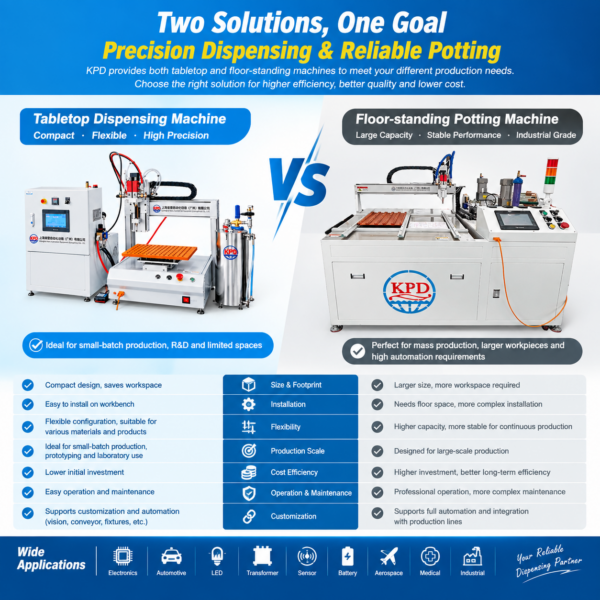
The choice usually comes down to two main configurations: Benchtop (Tabletop) Epoxy Dispensers and Industrial Floor-Standing Epoxy Potting Machines. Both technologies serve distinct production scales, throughput requirements, and budget parameters.
This guide breaks down the engineering differences, operational costs, technical specifications, and application scenarios to help you select the ideal dispensing platform for your production line.
Technical Overview: Core Differences at a Glance
Before examining specific criteria, it helps to understand how these two categories differ in architecture and scale:
- Benchtop (Tabletop) Epoxy Dispensers: Compact, self-contained, 3-axis or 4-axis motion systems engineered for small-to-medium batch production, R&D labs, and high-precision micro-dispensing. They feature small footprints and integrate easily into existing workbench setups.
- Industrial Floor-Standing Potting Machines: Heavy-duty, large-capacity automated platforms designed for continuous, high-volume manufacturing. They typically integrate large-volume pressurized tanks, vacuum degassing units, dynamic mixing heads, and multi-nozzle configurations.
Detailed Comparative Matrix
| Feature / Metric | Benchtop Epoxy Dispensers | Industrial Floor-Standing Dispensers |
| Footprint / Dimensions | Compact (~0.5 m² to 1 m² workbench area) | Large (1.5 m² to 4+ m² dedicated floor space) |
| Reservoir / Tank Capacity | to 1L–5L pressure tanks | 10L to 60L+ temperature-controlled stainless tanks |
| Flow Rate & Shot Size | Micro-dosing (0.001 ml to 50 ml/shot) | High flow rates (up to several liters per minute) |
| Mixing Technology | Static mixing nozzles, premixed & frozen syringes | Dynamic motor-driven mixing, high-shear static-dynamic |
| AB Ratio Control | Gear pumps / piston valves for fixed/simple ratios | Servo-driven gear/piston metering (1:1 to 100:1 adjustable) |
| Vacuum Degassing | Optional external syringe/reservoir degassing | Built-in inline vacuum potting & tank auto-degassing |
| Line Integration | Standalone manual loading; easy desktop relocation | Fully automated inline conveyor (SMEMA interface compliant) |
| Typical Investment Range | Low to Moderate ($5,000 – $10,000) | Moderate to High ($8,000 – $15,000+) |
5 Key Factors to Guide Your Selection
1. Production Volume & Cycle Time Requirements
If your facility processes low-to-medium batch runs, prototype testing, or high-mix low-volume (HMLV) orders, a benchtop epoxy dispenser offers the agility you need. Operator loading and unloading times complement the cycle speeds of desktop 3-axis XYZ gantry systems.
For 24/7 continuous mass production, floor-standing systems are necessary. Equipped with conveyor belts, auto-indexing stations, and multi-head dispensing nozzles, floor-standing units eliminate operator bottlenecks and drastically lower per-unit cycle times.
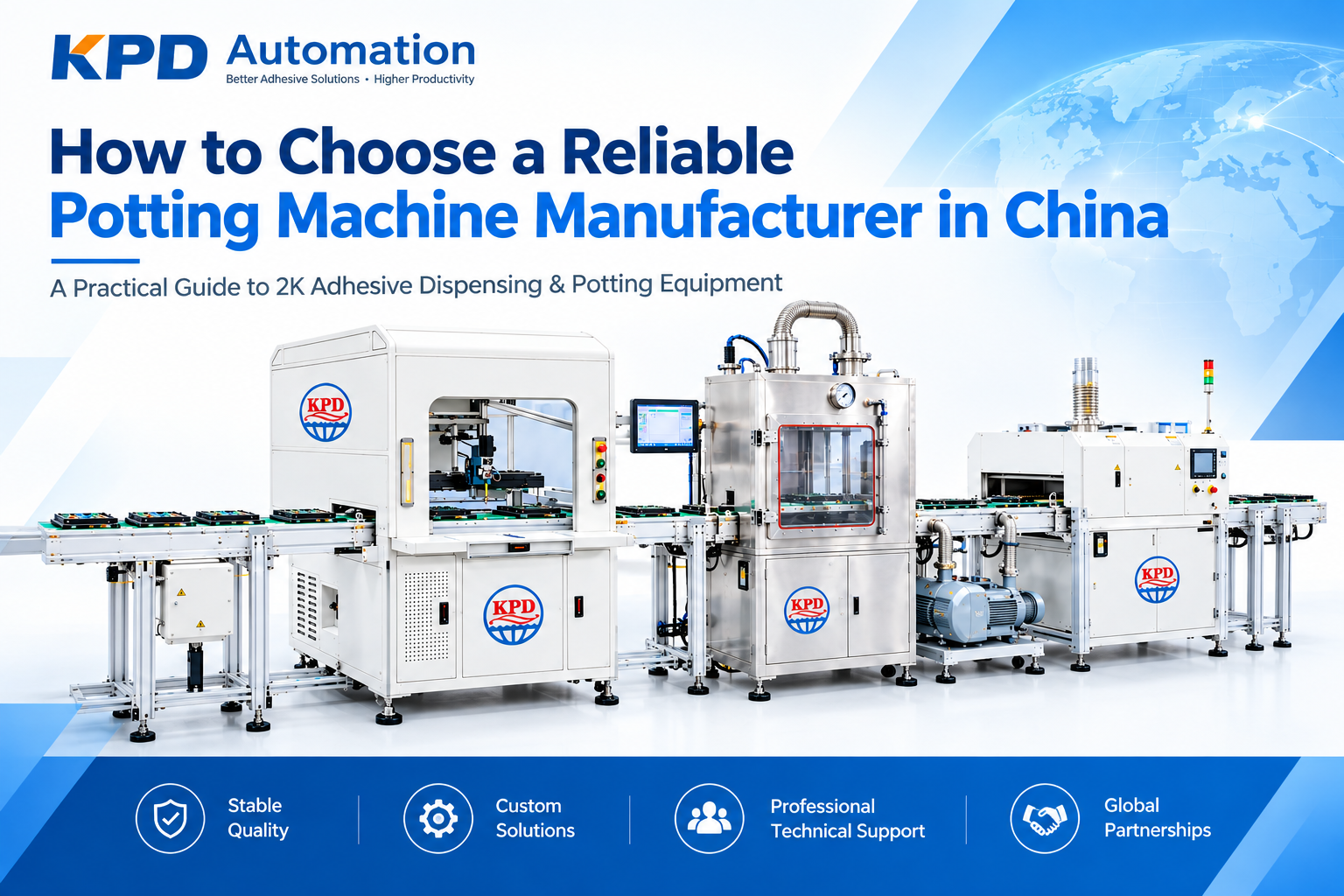
Image Description: Close-up of an industrial floor-standing epoxy machine with a dual-head dispenser operating over a PCB conveyor line inside a protective enclosure.
2. Material Chemistry: 1-Part vs. 2-Part (AB) Epoxy Systems
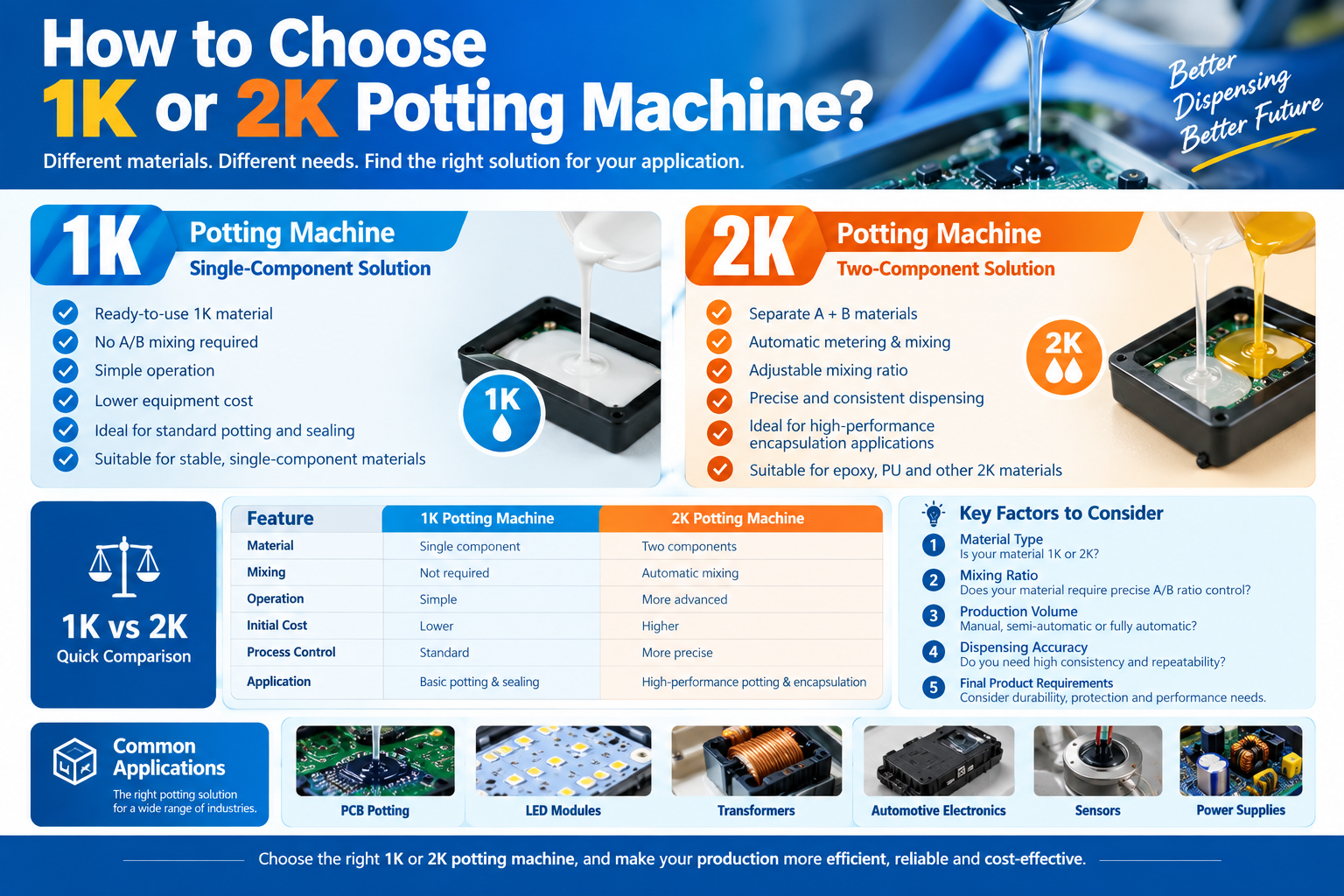
- Single-Component (1K) Epoxies & UV Resins: Benchtop dispensers excel here. Using pneumatic or positive-displacement syringe pumps, tabletop units achieve high volumetric repeatability without complex fluid lines.
- Two-Component (2K / AB) Resins: Two-part epoxies require precise metering (e.g., 100:10 or 100:50 by weight/volume) and thorough mixing to cure properly.
- Benchtop units use static mixers attached to dual-barrel cartridges or small pressure pots. They suit resins with forgiving mixing ratios and moderate viscosities.
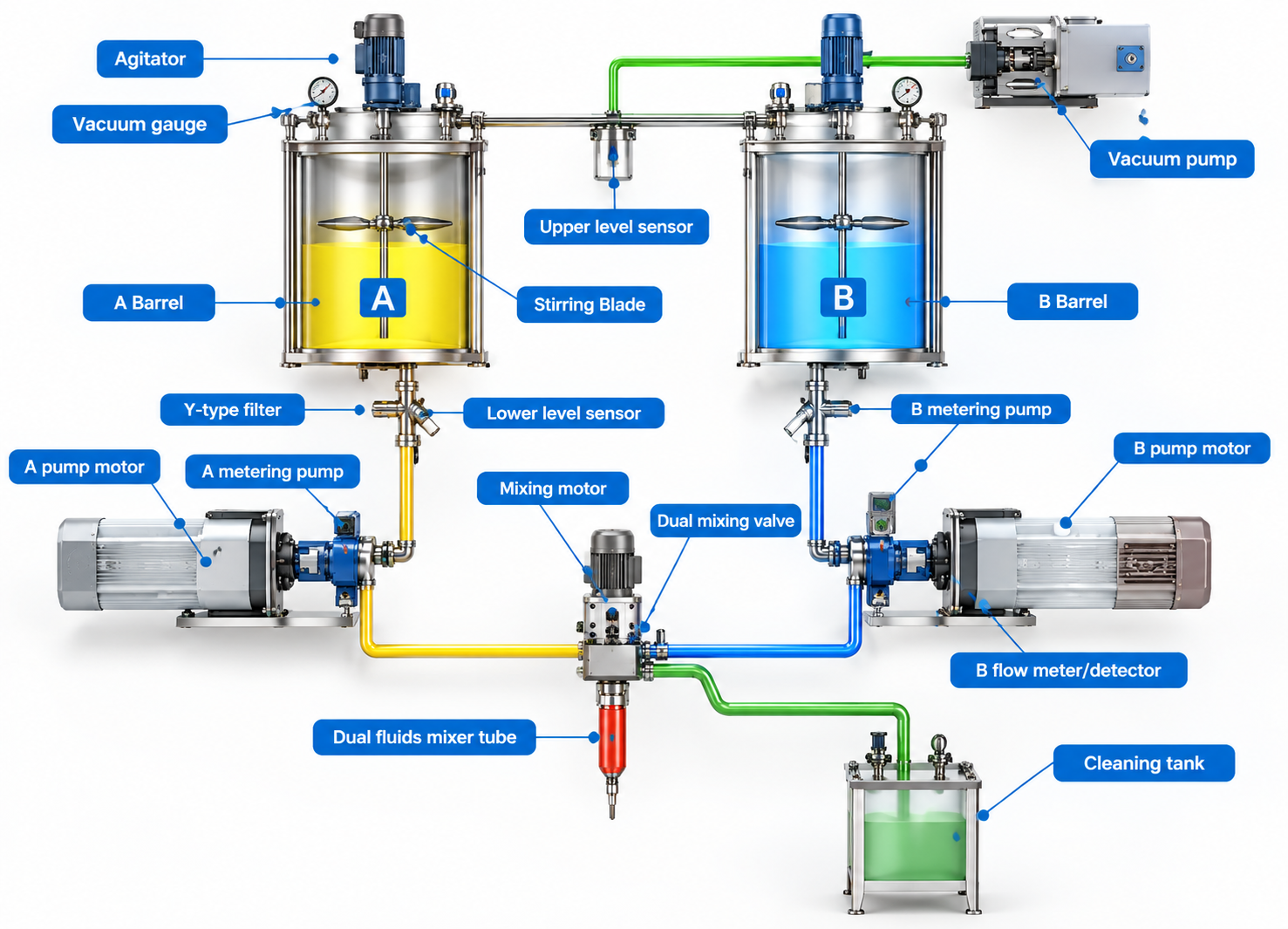
- Floor-standing units feature servo-driven gear or piston pumps capable of real-time ratio monitoring, continuous auto-recirculation (preventing filler settling), and dynamic high-shear mixing heads for high-viscosity or heavily filled resins.
3. Bubble Elimination & Vacuum Potting
Trapped air bubbles cause dielectric breakdown in electronic transformers, power supplies, and automotive sensors.
- If your application allows room-temperature curing under atmospheric pressure, a tabletop dispenser paired with pre-degassed resin reservoirs will suffice.
- If your product requires zero-void encapsulation (e.g., high-voltage ignition coils, underwater sensors, military avionics), an industrial floor-standing vacuum potting machine is mandatory. These systems degas materials inside heated tanks and dispense directly within a vacuum chamber.
4. Precision, Repeatability, and Motion Control
Desktop dispensing robots use precision stepper or servo motors with ball-screw drives, delivering positioning repeatability down to $\pm0.02\text{ mm}$. This makes them ideal for micro-bead laying, dam-and-fill applications, and IC encapsulation.
Floor-standing machines accommodate heavier payload end-effectors, multi-axis robotic arms, and complex vision-guided positioning systems (CCD cameras) to correct part alignment automatically on moving conveyor lines.
Image Description: High-magnification shot of a precision dispensing needle mounted on a desktop robot applying a micro-bead of epoxy resin onto a printed circuit board.
5. Facility Space and Maintenance Flexibility
- Benchtop: Modular, easily moved between production lines, and runs on standard electrical power ($110\text{V}/220\text{V}$) and clean dry air ($0.4 – 0.6\text{ MPa}$). Maintenance involves quick syringe or static mixer replacements.
- Floor-Standing: Requires dedicated floor space, heavy-duty pneumatic/electrical hookups, and integrated exhaust ventilation. Maintenance involves automated flush cycles, solvent wash systems, and periodic pump seal replacements.
Typical Industry Applications
Choose a Benchtop Epoxy Dispenser for:
- PCB Repair & Small-Scale Assembly: Dam-and-fill, underfill, wire bonding protection.
- LED Driver Potting (Low Volume): Dispensing thermal conductive epoxy into compact housings.
- Medical Device Manufacturing: Micro-fluidic device sealing, catheter needle bonding.
- R&D and Prototyping Labs: Testing material formulations and developing manufacturing processes.
Choose an Industrial Floor-Standing Dispenser for:
- Automotive Electronics & EV Batteries: Battery module structural bonding, BMS board potting, sensor encapsulation.
- Renewable Energy & Power Electronics: Solar inverter potting, transformer encapsulation, wind turbine controller sealing.
- High-Volume LED Lighting: Continuous linear potting for outdoor strip lights and architectural fixtures.
Decision Checklist: Which One Should You Buy?
Answer these simple questions to narrow down your choice:
- What is your daily target output?
- $< 500$ units/day → Benchtop Epoxy Dispenser
- $> 2,000+$ units/day → Floor-Standing Dispensing System
- What is your material container size?
- 3L to 5L buckets → Benchtop
- 20L drums to 60L barrels→Floor-Standing
- Does your process require fully automatic line integration (SMEMA)?
- No → Benchtop
- Yes →Floor-Standing
- Is inline vacuum degassing required during the dispensing phase?
- No → Benchtop
- Yes→ Floor-Standing
Conclusion & Next Steps
Both benchtop and floor-standing epoxy dispensers offer distinct operational advantages. Choosing the right machine depends on aligning your current production volume, material chemistry, and automation goals with the right equipment scale.
Starting with a benchtop unit allows growing manufacturers to maintain high precision at a low initial cost, while scaling up to a floor-standing system provides the throughput needed for full industrial automation.
Need Help Choosing the Right Epoxy Dispensing Machine?
Our engineering team specializes in custom fluid control and automated resin potting systems tailored to your production requirements.
[Contact Our Technical Sales Engineers Today] for a free material dispensing evaluation or to request a custom machinery quote!
Whatsapp+86 134 2516 4065